
You’re Hiring Marketers Wrong

Welcome to the first edition of Marketing Meditations on Substack!!!
Here we go with three meditations: something to think about, a “how-to” resource, and a marketing deep dive. Ommmmmm.
Something to Think About
“How-To”
Generate consistent on-brand images with AI
If you’re using AI to generate supporting images for your content, you may be getting tired of seeing images that all seem to have this same ochre-washed DALL-E style from ChatGPT.

I know I was.
Then a designer friend of mine, Todd Reynolds, did a project for one of our clients.
The client launched a new website and wanted a consistent image style to use in their newsletter. So Todd worked with them to find an image style that was on-brand and evoked the look and feel they were after.
If you were early in the AI image generation scene, you likely had a Midjourney account. Since then, lots of folks have switched to ChatGPT, Grok, Gemini, etc. as those models have gotten WAY better.
I’m probably going to give you a reason to reconsider MidJourney.
MidJourney has a feature called “Moodboards” and it’s perfect for solving the problem of consistency in the look and feel of your images.
A moodboard is a bunch of images that evoke the look you’re after. It’s like a look book. Images can come from anywhere, but I like to feed it AI-generated images.
When you plug the moodboard into your prompt, it generates new images that look like they belong with your reference images. Here’s how I created one.
I wanted images that used the CMO Zen brand colors. So I made a color palette image.

Then I used that image as a style reference in Midjourney and created a bunch of images that fit the Zen style. I used watercolors, ink washes, and Japanese sumi-e inspired images. Here’s where my moodboard ended up.
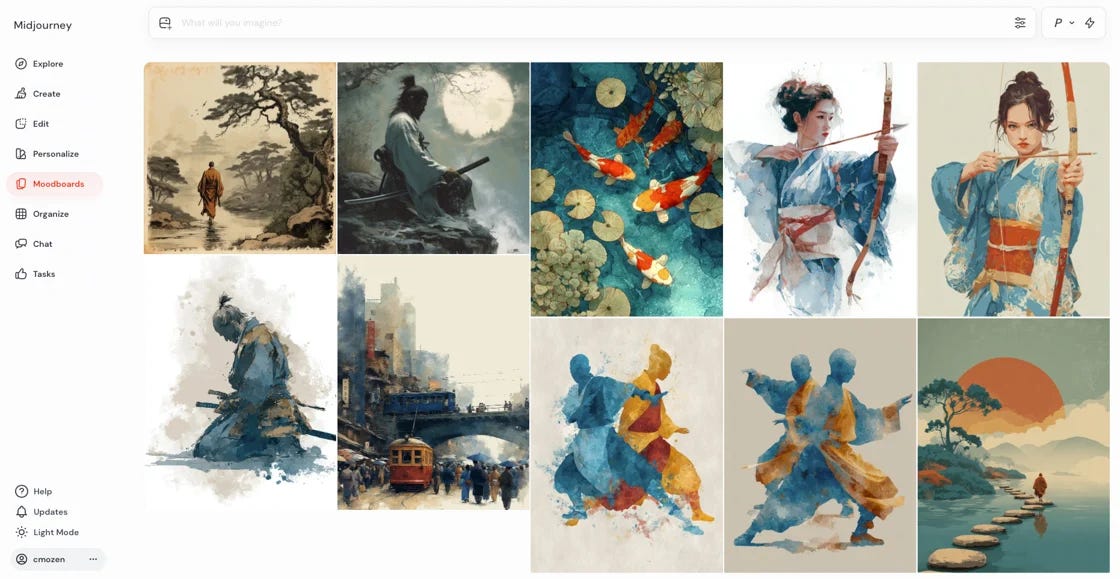
All the images in the next section of this newsletter were created using this moodboard in the prompt.
Here’s the step by step:
Create a MidJourney account
Create a color palette image that contains your brand colors (you could use only your primary color).
Build images that have the look and feel you are after and use the color palette image as a style reference. You may want to play around with the reference weight (--sw 1-1000).
Add those images to a moodboard.
Reference that moodboard in your subsequent image prompts (click the little P icon in the top right).
Voila! You’ve got a very reliable recipe for generating consistent images that match your company brand and style.
A Marketing Deep Dive

The CEO’s Guide To Great Marketing Hires
If you’re a CEO or founder and your last marketing hire didn’t deliver, odds are the issue ran deeper than the candidate.
For many companies, the problem isn’t talent.
It’s the gap between what’s written in a job description and what’s really needed to drive growth.
That gap leads to roles that look great on paper but fall apart in practice — costing time, budget, and momentum.
We reviewed dozens of senior marketing job descriptions— across industries, stages, and titles—to unpack why so many marketing hires underperform...
...and what the most effective founders and execs do differently to get it right.
The Copy-Paste Problem
Across thousands of job postings, the language used to describe marketing leadership roles is nearly indistinguishable.
Regardless of industry or experience level (Director and above), marketing job descriptions include language like:
“Develop marketing strategy”
“Lead and mentor a team”
“Own brand and messaging”
“Drive growth and demand generation”
“Oversee campaigns and digital channels”
In fact, in our research marketing job postings across industries and roles (think Director, Head of Marketing, VP Marketing, SVP Marketing, CMO) are 90% identical!!!
Every job description says these same things (and a bunch of others). But not every job actually needs the same things.
Your VP of Demand Gen should not look like your CMO and yet… the descriptions say are identical.
The Source of Discord
Marketing roles tend to be vague for a few reasons:
Marketing as a discipline is broad
Executives often don’t know what kind of marketer they actually need
Quantifying what one person cand do alone is difficult
The job description tends to focus more on responsibilities than on defining outcomes.
This leads to what we call the “Unicorn Stack,” one job description trying to fill too many distinct specialties such as:
Strategy
Creative
Analytics
Events
Product Marketing
Comms & PR
Social Media
Paid Ads
+ More
In most business functions outside of marketing, the scope is tighter; roles are clearer. But with marketing, it’s all too easy for a wishlist to replace a success plan.
When Marketing Hires Don’t Work Out

When marketing hires fail, here’s what often went wrong:
The scope of the role outpaced what one hire could deliver alone.
Goals and expectations weren’t aligned across the leadership team.
You wanted a strategic partner, but an individual contributor role was implemented.
It’s usually not a talent problem. It’s a scoping problem.
When that hire doesn’t work out, it can delay launches, waste quarters, and lower confidence in the marketing function, making the next hire even harder.
The Risks of Vibe-Hiring

In the absence of clarity, most CEOs default to signals:
Did they work at a company I respect?
Do they “get it” in the interview?
Did they say the right things about metrics and brand?
These signals are not a substitute for aligned expectations.
If you can’t define what success looks like, and how the marketing function will contribute to specific business goals, then even the best hire has an increased risk of missing the mark.
How High-Performing Teams Scope Roles Differently
The best marketing hires are scoped with intention. Meaning:
The leadership team was aligned on the role’s focus and success criteria.
The CEO allows the marketing vision to shape the job description.
The job description was focused, realistic, and clearly tied to business goals.
The interviews were structured to evaluate specific capabilities aligned with the role’s goals — not just general marketing fluency or relationship fit.
Clarity isn’t a luxury. It’s the price of entry for results.

Tips for CEOs
I speak with a lot of CEOs who aren’t marketers, they don’t have a marketing background or education. Makes sense to build out the skills you need, right?
One thing squarely in the CEOs job description is vision. Even if marketing feels like a foreign country, an effective marketing hire usually means you can’t delegate clarity.
Before you write the job description, ask yourself:
Which business objectives are tied to this hire?
What’s more important — strategy or execution?
Where will they need to go deep, and where can they rely on others?
Do I need a builder, a maintainer, or a scaler?
What will they NOT own?
Build your job description and expectations around your answers to these questions.
Keep in mind, if you can’t explain the role to yourself, no candidate will succeed in it.

Ready to make a great hire?
Revisit the scope — not just the resume.
Don’t delegate clarity to HR or a recruiter.
Make the job description a reflection of business goals, not a wishlist of tasks.
Align your KPIs and Quarterly Reviews around those business goals.
Consider fractional or role-specific support if you’re not ready to hire a full-time CMO (or you just need to pressure-test what you think you want).
Expect better outcomes by defining success up front.
Owning clarity doesn’t mean you’re on your own. A seasoned perspective can help confirm your thinking and move forward with confidence. If you could use an experienced set of eyes, reach out to CMO Zen for a strategy call—no pitch, just perspective.
If this was helpful, we pulled it into a handy reference for you.
The CEO’s Guide to Great Marketing Hires
Namaste,
Chad Jardine, CEO
CMO Zen